- java.lang.Object
-
- javafx.scene.Node
-
- javafx.scene.Parent
-
- javafx.scene.layout.Region
-
- javafx.scene.control.Control
-
- org.controlsfx.control.RangeSlider
-
- All Implemented Interfaces:
- javafx.css.Styleable, javafx.event.EventTarget, javafx.scene.control.Skinnable
public class RangeSlider
extends javafx.scene.control.Control
The RangeSlider control is simply a JavaFXSlidercontrol with support for two 'thumbs', rather than one. A thumb is the non-technical name for the draggable area inside the Slider / RangeSlider that allows for a value to be set.Because the RangeSlider has two thumbs, it also has a few additional rules and user interactions:
- The 'lower value' thumb can not move past the 'higher value' thumb.
- Whereas the
Slidercontrol only has onevalueproperty, the RangeSlider has alow valueand ahigh valueproperty, not surprisingly represented by the 'low value' and 'high value' thumbs. - The area between the low and high values represents the allowable range. For example, if the low value is 2 and the high value is 8, then the allowable range is between 2 and 8.
- The allowable range area is rendered differently. This area is able to be dragged with mouse / touch input to allow for the entire range to be modified. For example, following on from the previous example of the allowable range being between 2 and 8, if the user drags the range bar to the right, the low value will adjust to 3, and the high value 9, and so on until the user stops adjusting.
Screenshots
Because the RangeSlider supports both horizontal and verticalorientation, there are two screenshots below:Horizontal: 
Vertical: 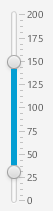
Code Samples
Instantiating a RangeSlider is simple. The first decision is to decide whether a horizontal or a vertical track is more appropriate. By default RangeSlider instances are horizontal, but this can be changed by setting theorientationproperty.Once the orientation is determined, the next most important decision is to determine what the
min/maxand defaultlow/highvalues are. The min / max values represent the smallest and largest legal values for the thumbs to be set to, whereas the low / high values represent where the thumbs are currently, within the bounds of the min / max values. Because all four values are required in all circumstances, they are all required parameters to instantiate a RangeSlider: the constructor takes four doubles, representing min, max, lowValue and highValue (in that order).For example, here is a simple horizontal RangeSlider that has a minimum value of 0, a maximum value of 100, a low value of 10 and a high value of 90:
final RangeSlider hSlider = new RangeSlider(0, 100, 10, 90);To configure the hSlider to look like the RangeSlider in the horizontal RangeSlider screenshot above only requires a few additional properties to be set:
 final RangeSlider hSlider = new RangeSlider(0, 100, 10, 90);
 hSlider.setShowTickMarks(true);
 hSlider.setShowTickLabels(true);
 hSlider.setBlockIncrement(10);
To create a vertical slider, simply do the following:
 final RangeSlider vSlider = new RangeSlider(0, 200, 30, 150);
 vSlider.setOrientation(Orientation.VERTICAL);
This code creates a RangeSlider with a min value of 0, a max value of 200, a low value of 30, and a high value of 150.
- See Also:
Slider
-
-
Property Summary
All Methods Instance Methods Concrete Methods Type Property and Description javafx.beans.property.DoublePropertyblockIncrementThe amount by which to adjust the slider if the track of the slider is clicked.javafx.beans.property.BooleanPropertyhighValueChangingWhen true, indicates the current high value of this RangeSlider is changing.javafx.beans.property.DoublePropertyhighValuejavafx.beans.property.ObjectProperty<javafx.util.StringConverter<java.lang.Number>>labelFormatterStringConverter used to format tick mark labels.javafx.beans.property.BooleanPropertylowValueChangingWhen true, indicates the current low value of this RangeSlider is changing.javafx.beans.property.DoublePropertylowValuejavafx.beans.property.DoublePropertymajorTickUnitThe unit distance between major tick marks.javafx.beans.property.DoublePropertymaxjavafx.beans.property.IntegerPropertyminorTickCountThe number of minor ticks to place between any two major ticks.javafx.beans.property.DoublePropertyminjavafx.beans.property.ObjectProperty<javafx.geometry.Orientation>orientationThe orientation of theSlidercan either be horizontal or vertical.javafx.beans.property.BooleanPropertyshowTickLabelsIndicates that the labels for tick marks should be shown.javafx.beans.property.BooleanPropertyshowTickMarksjavafx.beans.property.BooleanPropertysnapToTicksIndicates whether thelowValueProperty()value} /highValueProperty()value} of theSlidershould always be aligned with the tick marks.-
Properties inherited from class javafx.scene.control.Control
contextMenu, skinClassName, skin, tooltip
-
Properties inherited from class javafx.scene.layout.Region
background, border, cacheShape, centerShape, height, insets, maxHeight, maxWidth, minHeight, minWidth, opaqueInsets, padding, prefHeight, prefWidth, scaleShape, shape, snapToPixel, width
-
Properties inherited from class javafx.scene.Node
accessibleHelp, accessibleRoleDescription, accessibleRole, accessibleText, blendMode, boundsInLocal, boundsInParent, cacheHint, cache, clip, cursor, depthTest, disabled, disable, effectiveNodeOrientation, effect, eventDispatcher, focused, focusTraversable, hover, id, impl_showMnemonics, impl_treeVisible, inputMethodRequests, layoutBounds, layoutX, layoutY, localToParentTransform, localToSceneTransform, managed, mouseTransparent, nodeOrientation, onContextMenuRequested, onDragDetected, onDragDone, onDragDropped, onDragEntered, onDragExited, onDragOver, onInputMethodTextChanged, onKeyPressed, onKeyReleased, onKeyTyped, onMouseClicked, onMouseDragEntered, onMouseDragExited, onMouseDragged, onMouseDragOver, onMouseDragReleased, onMouseEntered, onMouseExited, onMouseMoved, onMousePressed, onMouseReleased, onRotate, onRotationFinished, onRotationStarted, onScrollFinished, onScroll, onScrollStarted, onSwipeDown, onSwipeLeft, onSwipeRight, onSwipeUp, onTouchMoved, onTouchPressed, onTouchReleased, onTouchStationary, onZoomFinished, onZoom, onZoomStarted, opacity, parent, pickOnBounds, pressed, rotate, rotationAxis, scaleX, scaleY, scaleZ, scene, style, translateX, translateY, translateZ, visible
-
-
Constructor Summary
Constructors Constructor and Description RangeSlider()Creates a new RangeSlider instance using default values of 0.0, 0.25, 0.75 and 1.0 for min/lowValue/highValue/max, respectively.RangeSlider(double min, double max, double lowValue, double highValue)Instantiates a default, horizontal RangeSlider with the specified min/max/low/high values.
-
Method Summary
All Methods Static Methods Instance Methods Concrete Methods Modifier and Type Method and Description voidadjustHighValue(double newValue)voidadjustLowValue(double newValue)javafx.beans.property.DoublePropertyblockIncrementProperty()The amount by which to adjust the slider if the track of the slider is clicked.protected javafx.scene.control.Skin<?>createDefaultSkin()voiddecrementHighValue()Decrements thehigh valueby theblock incrementamount.voiddecrementLowValue()Decrements thelow valueby theblock incrementamount.doublegetBlockIncrement()static java.util.List<javafx.css.CssMetaData<? extends javafx.css.Styleable,?>>getClassCssMetaData()java.util.List<javafx.css.CssMetaData<? extends javafx.css.Styleable,?>>getControlCssMetaData()doublegetHighValue()Returns the current high value for the range slider.javafx.util.StringConverter<java.lang.Number>getLabelFormatter()Gets the value of the property tickLabelFormatter.doublegetLowValue()Returns the current low value for the range slider.doublegetMajorTickUnit()doublegetMax()doublegetMin()intgetMinorTickCount()javafx.geometry.OrientationgetOrientation()java.lang.StringgetUserAgentStylesheet()protected java.lang.StringgetUserAgentStylesheet(java.lang.Class<?> clazz, java.lang.String fileName)A helper method that ensures that the resource based lookup of the user agent stylesheet only happens once.javafx.beans.property.BooleanPropertyhighValueChangingProperty()When true, indicates the current high value of this RangeSlider is changing.javafx.beans.property.DoublePropertyhighValueProperty()voidincrementHighValue()Increments thehigh valueby theblock incrementamount.voidincrementLowValue()Increments thelow valueby theblock incrementamount.booleanisHighValueChanging()Returns whether or not the high value of this RangeSlider is currently changing.booleanisLowValueChanging()Returns whether or not the low value of this RangeSlider is currently changing.booleanisShowTickLabels()booleanisShowTickMarks()booleanisSnapToTicks()javafx.beans.property.ObjectProperty<javafx.util.StringConverter<java.lang.Number>>labelFormatterProperty()StringConverter used to format tick mark labels.javafx.beans.property.BooleanPropertylowValueChangingProperty()When true, indicates the current low value of this RangeSlider is changing.javafx.beans.property.DoublePropertylowValueProperty()javafx.beans.property.DoublePropertymajorTickUnitProperty()The unit distance between major tick marks.javafx.beans.property.DoublePropertymaxProperty()javafx.beans.property.IntegerPropertyminorTickCountProperty()The number of minor ticks to place between any two major ticks.javafx.beans.property.DoublePropertyminProperty()javafx.beans.property.ObjectProperty<javafx.geometry.Orientation>orientationProperty()The orientation of theSlidercan either be horizontal or vertical.voidsetBlockIncrement(double value)Sets the amount by which to adjust the slider if the track of the slider is clicked.voidsetHighValue(double d)voidsetHighValueChanging(boolean value)Call this when high low value is changing.voidsetLabelFormatter(javafx.util.StringConverter<java.lang.Number> value)Sets the value of the property tickLabelFormatter.voidsetLowValue(double d)voidsetLowValueChanging(boolean value)Call this when the low value is changing.voidsetMajorTickUnit(double value)Sets the unit distance between major tick marks.voidsetMax(double value)Sets the maximum value for this Slider.voidsetMin(double value)Sets the minimum value for this Slider.voidsetMinorTickCount(int value)Sets the number of minor ticks to place between any two major ticks.voidsetOrientation(javafx.geometry.Orientation value)Sets the orientation of the Slider.voidsetShowTickLabels(boolean value)Sets whether labels of tick marks should be shown or not.voidsetShowTickMarks(boolean value)Specifies whether theSkinimplementation should show tick marks.voidsetSnapToTicks(boolean value)Sets the value of SnapToTicks.javafx.beans.property.BooleanPropertyshowTickLabelsProperty()Indicates that the labels for tick marks should be shown.javafx.beans.property.BooleanPropertyshowTickMarksProperty()javafx.beans.property.BooleanPropertysnapToTicksProperty()Indicates whether thelowValueProperty()value} /highValueProperty()value} of theSlidershould always be aligned with the tick marks.-
Methods inherited from class javafx.scene.control.Control
computeMaxHeight, computeMaxWidth, computeMinHeight, computeMinWidth, computePrefHeight, computePrefWidth, contextMenuProperty, executeAccessibleAction, getBaselineOffset, getContextMenu, getCssMetaData, getSkin, getTooltip, impl_cssGetFocusTraversableInitialValue, impl_processCSS, isResizable, layoutChildren, queryAccessibleAttribute, setContextMenu, setSkin, setTooltip, skinClassNameProperty, skinProperty, tooltipProperty
-
Methods inherited from class javafx.scene.layout.Region
backgroundProperty, borderProperty, cacheShapeProperty, centerShapeProperty, getBackground, getBorder, getHeight, getInsets, getMaxHeight, getMaxWidth, getMinHeight, getMinWidth, getOpaqueInsets, getPadding, getPrefHeight, getPrefWidth, getShape, getWidth, heightProperty, impl_computeContains, impl_computeGeomBounds, impl_computeLayoutBounds, impl_createPeer, impl_notifyLayoutBoundsChanged, impl_pickNodeLocal, impl_updatePeer, insetsProperty, isCacheShape, isCenterShape, isScaleShape, isSnapToPixel, layoutInArea, layoutInArea, layoutInArea, layoutInArea, maxHeight, maxHeightProperty, maxWidth, maxWidthProperty, minHeight, minHeightProperty, minWidth, minWidthProperty, opaqueInsetsProperty, paddingProperty, positionInArea, positionInArea, prefHeight, prefHeightProperty, prefWidth, prefWidthProperty, resize, scaleShapeProperty, setBackground, setBorder, setCacheShape, setCenterShape, setHeight, setMaxHeight, setMaxSize, setMaxWidth, setMinHeight, setMinSize, setMinWidth, setOpaqueInsets, setPadding, setPrefHeight, setPrefSize, setPrefWidth, setScaleShape, setShape, setSnapToPixel, setWidth, shapeProperty, snappedBottomInset, snappedLeftInset, snappedRightInset, snappedTopInset, snapPosition, snapSize, snapSpace, snapToPixelProperty, widthProperty
-
Methods inherited from class javafx.scene.Parent
getChildren, getChildrenUnmodifiable, getImpl_traversalEngine, getManagedChildren, getStylesheets, impl_getAllParentStylesheets, impl_processMXNode, impl_traversalEngineProperty, isNeedsLayout, layout, lookup, needsLayoutProperty, requestLayout, requestParentLayout, setImpl_traversalEngine, setNeedsLayout, updateBounds
-
Methods inherited from class javafx.scene.Node
accessibleHelpProperty, accessibleRoleDescriptionProperty, accessibleRoleProperty, accessibleTextProperty, addEventFilter, addEventHandler, applyCss, autosize, blendModeProperty, boundsInLocalProperty, boundsInParentProperty, buildEventDispatchChain, cacheHintProperty, cacheProperty, clipProperty, computeAreaInScreen, contains, contains, containsBounds, cursorProperty, depthTestProperty, disabledProperty, disableProperty, effectiveNodeOrientationProperty, effectProperty, eventDispatcherProperty, fireEvent, focusedProperty, focusTraversableProperty, getAccessibleHelp, getAccessibleRole, getAccessibleRoleDescription, getAccessibleText, getBlendMode, getBoundsInLocal, getBoundsInParent, getCacheHint, getClip, getContentBias, getCursor, getDepthTest, getEffect, getEffectiveNodeOrientation, getEventDispatcher, getId, getInputMethodRequests, getLayoutBounds, getLayoutX, getLayoutY, getLocalToParentTransform, getLocalToSceneTransform, getNodeOrientation, getOnContextMenuRequested, getOnDragDetected, getOnDragDone, getOnDragDropped, getOnDragEntered, getOnDragExited, getOnDragOver, getOnInputMethodTextChanged, getOnKeyPressed, getOnKeyReleased, getOnKeyTyped, getOnMouseClicked, getOnMouseDragEntered, getOnMouseDragExited, getOnMouseDragged, getOnMouseDragOver, getOnMouseDragReleased, getOnMouseEntered, getOnMouseExited, getOnMouseMoved, getOnMousePressed, getOnMouseReleased, getOnRotate, getOnRotationFinished, getOnRotationStarted, getOnScroll, getOnScrollFinished, getOnScrollStarted, getOnSwipeDown, getOnSwipeLeft, getOnSwipeRight, getOnSwipeUp, getOnTouchMoved, getOnTouchPressed, getOnTouchReleased, getOnTouchStationary, getOnZoom, getOnZoomFinished, getOnZoomStarted, getOpacity, getParent, getProperties, getPseudoClassStates, getRotate, getRotationAxis, getScaleX, getScaleY, getScaleZ, getScene, getStyle, getStyleableParent, getStyleClass, getTransforms, getTranslateX, getTranslateY, getTranslateZ, getTypeSelector, getUserData, hasProperties, hoverProperty, idProperty, impl_clearDirty, impl_computeIntersects, impl_cssGetCursorInitialValue, impl_findStyles, impl_geomChanged, impl_getLeafTransform, impl_getMatchingStyles, impl_getPeer, impl_getPivotX, impl_getPivotY, impl_getPivotZ, impl_getStyleMap, impl_hasTransforms, impl_intersects, impl_intersectsBounds, impl_isDirty, impl_isDirtyEmpty, impl_isShowMnemonics, impl_isTreeVisible, impl_layoutBoundsChanged, impl_markDirty, impl_pickNode, impl_processCSS, impl_reapplyCSS, impl_setShowMnemonics, impl_setStyleMap, impl_showMnemonicsProperty, impl_syncPeer, impl_transformsChanged, impl_traverse, impl_treeVisibleProperty, inputMethodRequestsProperty, intersects, intersects, isCache, isDisable, isDisabled, isFocused, isFocusTraversable, isHover, isManaged, isMouseTransparent, isPickOnBounds, isPressed, isVisible, layoutBoundsProperty, layoutXProperty, layoutYProperty, localToParent, localToParent, localToParent, localToParent, localToParent, localToParentTransformProperty, localToScene, localToScene, localToScene, localToScene, localToScene, localToScene, localToScene, localToScene, localToScene, localToScene, localToSceneTransformProperty, localToScreen, localToScreen, localToScreen, localToScreen, localToScreen, lookupAll, managedProperty, mouseTransparentProperty, nodeOrientationProperty, notifyAccessibleAttributeChanged, onContextMenuRequestedProperty, onDragDetectedProperty, onDragDoneProperty, onDragDroppedProperty, onDragEnteredProperty, onDragExitedProperty, onDragOverProperty, onInputMethodTextChangedProperty, onKeyPressedProperty, onKeyReleasedProperty, onKeyTypedProperty, onMouseClickedProperty, onMouseDragEnteredProperty, onMouseDragExitedProperty, onMouseDraggedProperty, onMouseDragOverProperty, onMouseDragReleasedProperty, onMouseEnteredProperty, onMouseExitedProperty, onMouseMovedProperty, onMousePressedProperty, onMouseReleasedProperty, onRotateProperty, onRotationFinishedProperty, onRotationStartedProperty, onScrollFinishedProperty, onScrollProperty, onScrollStartedProperty, onSwipeDownProperty, onSwipeLeftProperty, onSwipeRightProperty, onSwipeUpProperty, onTouchMovedProperty, onTouchPressedProperty, onTouchReleasedProperty, onTouchStationaryProperty, onZoomFinishedProperty, onZoomProperty, onZoomStartedProperty, opacityProperty, parentProperty, parentToLocal, parentToLocal, parentToLocal, parentToLocal, parentToLocal, pickOnBoundsProperty, pressedProperty, pseudoClassStateChanged, relocate, removeEventFilter, removeEventHandler, requestFocus, resizeRelocate, rotateProperty, rotationAxisProperty, scaleXProperty, scaleYProperty, scaleZProperty, sceneProperty, sceneToLocal, sceneToLocal, sceneToLocal, sceneToLocal, sceneToLocal, sceneToLocal, sceneToLocal, sceneToLocal, screenToLocal, screenToLocal, screenToLocal, setAccessibleHelp, setAccessibleRole, setAccessibleRoleDescription, setAccessibleText, setBlendMode, setCache, setCacheHint, setClip, setCursor, setDepthTest, setDisable, setDisabled, setEffect, setEventDispatcher, setEventHandler, setFocused, setFocusTraversable, setHover, setId, setInputMethodRequests, setLayoutX, setLayoutY, setManaged, setMouseTransparent, setNodeOrientation, setOnContextMenuRequested, setOnDragDetected, setOnDragDone, setOnDragDropped, setOnDragEntered, setOnDragExited, setOnDragOver, setOnInputMethodTextChanged, setOnKeyPressed, setOnKeyReleased, setOnKeyTyped, setOnMouseClicked, setOnMouseDragEntered, setOnMouseDragExited, setOnMouseDragged, setOnMouseDragOver, setOnMouseDragReleased, setOnMouseEntered, setOnMouseExited, setOnMouseMoved, setOnMousePressed, setOnMouseReleased, setOnRotate, setOnRotationFinished, setOnRotationStarted, setOnScroll, setOnScrollFinished, setOnScrollStarted, setOnSwipeDown, setOnSwipeLeft, setOnSwipeRight, setOnSwipeUp, setOnTouchMoved, setOnTouchPressed, setOnTouchReleased, setOnTouchStationary, setOnZoom, setOnZoomFinished, setOnZoomStarted, setOpacity, setPickOnBounds, setPressed, setRotate, setRotationAxis, setScaleX, setScaleY, setScaleZ, setStyle, setTranslateX, setTranslateY, setTranslateZ, setUserData, setVisible, snapshot, snapshot, startDragAndDrop, startFullDrag, styleProperty, toBack, toFront, toString, translateXProperty, translateYProperty, translateZProperty, usesMirroring, visibleProperty
-
-
-
-
Property Detail
-
lowValue
public final javafx.beans.property.DoubleProperty lowValueProperty
The low value property represents the current position of the low value thumb, and is within the allowable range as specified by theminandmaxproperties. By default this value is 0.- See Also:
getLowValue(),setLowValue(double)
-
lowValueChanging
public final javafx.beans.property.BooleanProperty lowValueChangingProperty
When true, indicates the current low value of this RangeSlider is changing. It provides notification that the low value is changing. Once the low value is computed, it is set back to false.- See Also:
isLowValueChanging(),setLowValueChanging(boolean)
-
highValue
public final javafx.beans.property.DoubleProperty highValueProperty
The high value property represents the current position of the high value thumb, and is within the allowable range as specified by theminandmaxproperties. By default this value is 100.- See Also:
getHighValue(),setHighValue(double)
-
highValueChanging
public final javafx.beans.property.BooleanProperty highValueChangingProperty
When true, indicates the current high value of this RangeSlider is changing. It provides notification that the high value is changing. Once the high value is computed, it is set back to false.
-
labelFormatter
public final javafx.beans.property.ObjectProperty<javafx.util.StringConverter<java.lang.Number>> labelFormatterProperty
StringConverter used to format tick mark labels. If null a default will be used.
-
max
public final javafx.beans.property.DoubleProperty maxProperty
- Returns:
- A DoubleProperty representing the maximum value of this Slider.
This must be a value greater than
min.
-
min
public final javafx.beans.property.DoubleProperty minProperty
- See Also:
getMin(),setMin(double)
-
snapToTicks
public final javafx.beans.property.BooleanProperty snapToTicksProperty
Indicates whether thelowValueProperty()value} /highValueProperty()value} of theSlidershould always be aligned with the tick marks. This is honored even if the tick marks are not shown.- Returns:
- A BooleanProperty.
-
majorTickUnit
public final javafx.beans.property.DoubleProperty majorTickUnitProperty
The unit distance between major tick marks. For example, if theminis 0 and themaxis 100 and themajorTickUnitis 25, then there would be 5 tick marks: one at position 0, one at position 25, one at position 50, one at position 75, and a final one at position 100.This value should be positive and should be a value less than the span. Out of range values are essentially the same as disabling tick marks.
- Returns:
- A DoubleProperty
-
minorTickCount
public final javafx.beans.property.IntegerProperty minorTickCountProperty
The number of minor ticks to place between any two major ticks. This number should be positive or zero. Out of range values will disable disable minor ticks, as will a value of zero.- Returns:
- An InterProperty
-
blockIncrement
public final javafx.beans.property.DoubleProperty blockIncrementProperty
The amount by which to adjust the slider if the track of the slider is clicked. This is used when manipulating the slider position using keys. IfsnapToTicksis true then the nearest tick mark to the adjusted value will be used.- Returns:
- A DoubleProperty
-
orientation
public final javafx.beans.property.ObjectProperty<javafx.geometry.Orientation> orientationProperty
The orientation of theSlidercan either be horizontal or vertical.- Returns:
- An Objectproperty representing the orientation of the Slider.
-
showTickLabels
public final javafx.beans.property.BooleanProperty showTickLabelsProperty
Indicates that the labels for tick marks should be shown. Typically aSkinimplementation will only show labels ifshowTickMarksis also true.- See Also:
isShowTickLabels(),setShowTickLabels(boolean)
-
showTickMarks
public final javafx.beans.property.BooleanProperty showTickMarksProperty
- Returns:
- A BooleanProperty that specifies whether the
Skinimplementation should show tick marks.
-
-
Constructor Detail
-
RangeSlider
public RangeSlider()
Creates a new RangeSlider instance using default values of 0.0, 0.25, 0.75 and 1.0 for min/lowValue/highValue/max, respectively.
-
RangeSlider
public RangeSlider(double min,
                   double max,
                   double lowValue,
                   double highValue)
Instantiates a default, horizontal RangeSlider with the specified min/max/low/high values.- Parameters:
min- The minimum allowable value that the RangeSlider will allow.max- The maximum allowable value that the RangeSlider will allow.lowValue- The initial value for the low value in the RangeSlider.highValue- The initial value for the high value in the RangeSlider.
-
-
Method Detail
-
getUserAgentStylesheet
public java.lang.String getUserAgentStylesheet()
- Overrides:
getUserAgentStylesheetin classjavafx.scene.layout.Region
-
createDefaultSkin
protected javafx.scene.control.Skin<?> createDefaultSkin()
- Overrides:
createDefaultSkinin classjavafx.scene.control.Control
-
lowValueProperty
public final javafx.beans.property.DoubleProperty lowValueProperty()
The low value property represents the current position of the low value thumb, and is within the allowable range as specified by theminandmaxproperties. By default this value is 0.- See Also:
getLowValue(),setLowValue(double)
-
setLowValue
public final void setLowValue(double d)
-
getLowValue
public final double getLowValue()
Returns the current low value for the range slider.
-
lowValueChangingProperty
public final javafx.beans.property.BooleanProperty lowValueChangingProperty()
When true, indicates the current low value of this RangeSlider is changing. It provides notification that the low value is changing. Once the low value is computed, it is set back to false.- See Also:
isLowValueChanging(),setLowValueChanging(boolean)
-
setLowValueChanging
public final void setLowValueChanging(boolean value)
Call this when the low value is changing.- Parameters:
value- True if the low value is changing, false otherwise.
-
isLowValueChanging
public final boolean isLowValueChanging()
Returns whether or not the low value of this RangeSlider is currently changing.
-
highValueProperty
public final javafx.beans.property.DoubleProperty highValueProperty()
The high value property represents the current position of the high value thumb, and is within the allowable range as specified by theminandmaxproperties. By default this value is 100.- See Also:
getHighValue(),setHighValue(double)
-
setHighValue
public final void setHighValue(double d)
-
getHighValue
public final double getHighValue()
Returns the current high value for the range slider.
-
highValueChangingProperty
public final javafx.beans.property.BooleanProperty highValueChangingProperty()
When true, indicates the current high value of this RangeSlider is changing. It provides notification that the high value is changing. Once the high value is computed, it is set back to false.
-
setHighValueChanging
public final void setHighValueChanging(boolean value)
Call this when high low value is changing.- Parameters:
value- True if the high value is changing, false otherwise.
-
isHighValueChanging
public final boolean isHighValueChanging()
Returns whether or not the high value of this RangeSlider is currently changing.
-
getLabelFormatter
public final javafx.util.StringConverter<java.lang.Number> getLabelFormatter()
Gets the value of the property tickLabelFormatter.- Returns:
- the value of the property tickLabelFormatter.
-
setLabelFormatter
public final void setLabelFormatter(javafx.util.StringConverter<java.lang.Number> value)
Sets the value of the property tickLabelFormatter.- Parameters:
value-
-
labelFormatterProperty
public final javafx.beans.property.ObjectProperty<javafx.util.StringConverter<java.lang.Number>> labelFormatterProperty()
StringConverter used to format tick mark labels. If null a default will be used.
-
incrementLowValue
public void incrementLowValue()
Increments thelow valueby theblock incrementamount.
-
decrementLowValue
public void decrementLowValue()
Decrements thelow valueby theblock incrementamount.
-
incrementHighValue
public void incrementHighValue()
Increments thehigh valueby theblock incrementamount.
-
decrementHighValue
public void decrementHighValue()
Decrements thehigh valueby theblock incrementamount.
-
adjustLowValue
public void adjustLowValue(double newValue)
AdjustslowValueto matchnewValue, or as closely as possible within the constraints imposed by theminandmaxproperties. This function also takes into accountsnapToTicks, which is the main difference betweenadjustLowValueandsetLowValue.
-
adjustHighValue
public void adjustHighValue(double newValue)
AdjustshighValueto matchnewValue, or as closely as possible within the constraints imposed by theminandmaxproperties. This function also takes into accountsnapToTicks, which is the main difference betweenadjustHighValueandsetHighValue.
-
setMax
public final void setMax(double value)
Sets the maximum value for this Slider.- Parameters:
value-
-
getMax
public final double getMax()
- Returns:
- The maximum value of this slider. 100 is returned if the maximum value has never been set.
-
maxProperty
public final javafx.beans.property.DoubleProperty maxProperty()
- Returns:
- A DoubleProperty representing the maximum value of this Slider.
This must be a value greater than
min.
-
setMin
public final void setMin(double value)
Sets the minimum value for this Slider.- Parameters:
value-
-
getMin
public final double getMin()
- Returns:
- the minimum value for this Slider. 0 is returned if the minimum has never been set.
-
minProperty
public final javafx.beans.property.DoubleProperty minProperty()
- See Also:
getMin(),setMin(double)
-
setSnapToTicks
public final void setSnapToTicks(boolean value)
Sets the value of SnapToTicks.- Parameters:
value-- See Also:
snapToTicksProperty()
-
isSnapToTicks
public final boolean isSnapToTicks()
- Returns:
- the value of SnapToTicks.
- See Also:
snapToTicksProperty()
-
snapToTicksProperty
public final javafx.beans.property.BooleanProperty snapToTicksProperty()
Indicates whether thelowValueProperty()value} /highValueProperty()value} of theSlidershould always be aligned with the tick marks. This is honored even if the tick marks are not shown.- Returns:
- A BooleanProperty.
-
setMajorTickUnit
public final void setMajorTickUnit(double value)
Sets the unit distance between major tick marks.- Parameters:
value-- See Also:
majorTickUnitProperty()
-
getMajorTickUnit
public final double getMajorTickUnit()
- Returns:
- The unit distance between major tick marks.
- See Also:
majorTickUnitProperty()
-
majorTickUnitProperty
public final javafx.beans.property.DoubleProperty majorTickUnitProperty()
The unit distance between major tick marks. For example, if theminis 0 and themaxis 100 and themajorTickUnitis 25, then there would be 5 tick marks: one at position 0, one at position 25, one at position 50, one at position 75, and a final one at position 100.This value should be positive and should be a value less than the span. Out of range values are essentially the same as disabling tick marks.
- Returns:
- A DoubleProperty
-
setMinorTickCount
public final void setMinorTickCount(int value)
Sets the number of minor ticks to place between any two major ticks.- Parameters:
value-- See Also:
minorTickCountProperty()
-
getMinorTickCount
public final int getMinorTickCount()
- Returns:
- The number of minor ticks to place between any two major ticks.
- See Also:
minorTickCountProperty()
-
minorTickCountProperty
public final javafx.beans.property.IntegerProperty minorTickCountProperty()
The number of minor ticks to place between any two major ticks. This number should be positive or zero. Out of range values will disable disable minor ticks, as will a value of zero.- Returns:
- An InterProperty
-
setBlockIncrement
public final void setBlockIncrement(double value)
Sets the amount by which to adjust the slider if the track of the slider is clicked.- Parameters:
value-- See Also:
blockIncrementProperty()
-
getBlockIncrement
public final double getBlockIncrement()
- Returns:
- The amount by which to adjust the slider if the track of the slider is clicked.
- See Also:
blockIncrementProperty()
-
blockIncrementProperty
public final javafx.beans.property.DoubleProperty blockIncrementProperty()
The amount by which to adjust the slider if the track of the slider is clicked. This is used when manipulating the slider position using keys. IfsnapToTicksis true then the nearest tick mark to the adjusted value will be used.- Returns:
- A DoubleProperty
-
setOrientation
public final void setOrientation(javafx.geometry.Orientation value)
Sets the orientation of the Slider.- Parameters:
value-
-
getOrientation
public final javafx.geometry.Orientation getOrientation()
- Returns:
- The orientation of the Slider.
Orientation.HORIZONTALis returned by default.
-
orientationProperty
public final javafx.beans.property.ObjectProperty<javafx.geometry.Orientation> orientationProperty()
The orientation of theSlidercan either be horizontal or vertical.- Returns:
- An Objectproperty representing the orientation of the Slider.
-
setShowTickLabels
public final void setShowTickLabels(boolean value)
Sets whether labels of tick marks should be shown or not.- Parameters:
value-
-
isShowTickLabels
public final boolean isShowTickLabels()
- Returns:
- whether labels of tick marks are being shown.
-
showTickLabelsProperty
public final javafx.beans.property.BooleanProperty showTickLabelsProperty()
Indicates that the labels for tick marks should be shown. Typically aSkinimplementation will only show labels ifshowTickMarksis also true.- See Also:
isShowTickLabels(),setShowTickLabels(boolean)
-
setShowTickMarks
public final void setShowTickMarks(boolean value)
Specifies whether theSkinimplementation should show tick marks.- Parameters:
value-
-
isShowTickMarks
public final boolean isShowTickMarks()
- Returns:
- whether the
Skinimplementation should show tick marks.
-
showTickMarksProperty
public final javafx.beans.property.BooleanProperty showTickMarksProperty()
- Returns:
- A BooleanProperty that specifies whether the
Skinimplementation should show tick marks.
-
getClassCssMetaData
public static java.util.List<javafx.css.CssMetaData<? extends javafx.css.Styleable,?>> getClassCssMetaData()
- Returns:
- The CssMetaData associated with this class, which may include the CssMetaData of its super classes.
-
getControlCssMetaData
public java.util.List<javafx.css.CssMetaData<? extends javafx.css.Styleable,?>> getControlCssMetaData()
- Overrides:
getControlCssMetaDatain classjavafx.scene.control.Control
-
getUserAgentStylesheet
protected final java.lang.String getUserAgentStylesheet(java.lang.Class<?> clazz,
                                                        java.lang.String fileName)
A helper method that ensures that the resource based lookup of the user agent stylesheet only happens once. Caches the external form of the resource.- Parameters:
clazz- the class used for the resource lookupfileName- the name of the user agent stylesheet- Returns:
- the external form of the user agent stylesheet (the path)
-
-